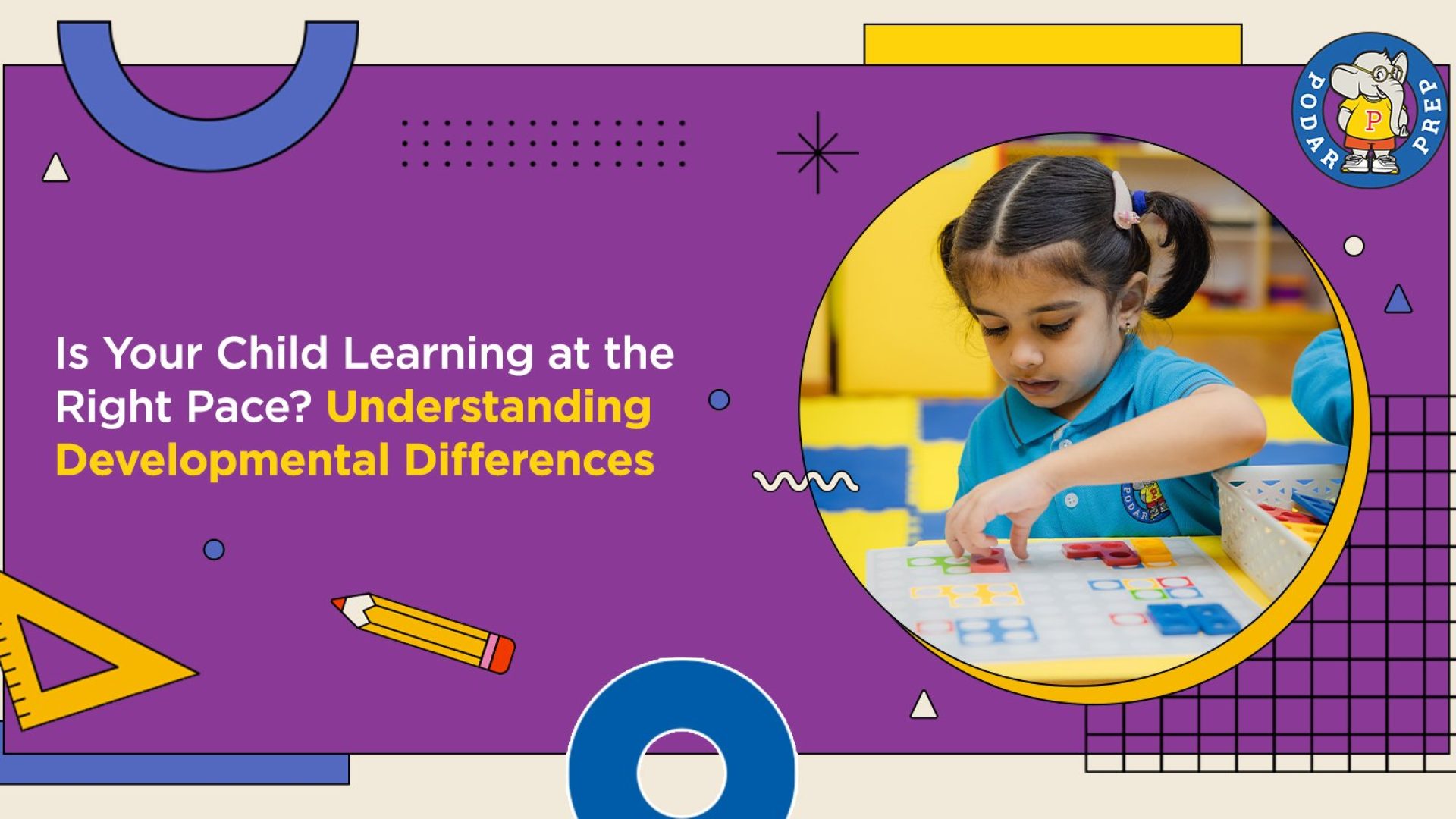
At a family gathering last month, your cousin’s four-year-old recited the alphabet without pausing once. Your own child was busy stacking blocks into a wobbly tower, showing zero interest in letters.
If a small knot formed in your stomach right then, you are not alone. Almost every parent has stood in that exact spot. It is easy to compare, but every child blossoms on their own unique timeline.
What looks like a delay might just be a brief pause before a big leap. Let’s walk through what your child’s unique learning pace really means, and how the right preschool helps them catch up faster.
What Does the Right Development Pace Mean for Preschoolers?
Developmental milestones are often treated like deadlines, but they were never meant to work that way. It is the age range by which most children develop a skill. Some children speak in full sentences by 3, others closer to 4, and both are within a normal range.
Learning pace is also not one single thing. A child can be quick with language and slower with fine motor skills, or confident socially while still falling behind in counting. Their early development happens in many domains simultaneously. And improvement in one domain often benefits the others.
Here is a quick look at the main areas to watch:
| Domain | What It Looks Like at This Age |
| Language | Vocabulary, sentence-building, listening |
| Motor | Balance, coordination, pencil grip |
| Social-emotional | Sharing, self-regulation, empathy |
| Cognitive | Problem-solving, memory, sequencing |
Why Do Some Children Reach Milestones Sooner or Later Than Others?
Kids reach their milestones at different times, and this is perfectly normal. A huge part of this comes down to simple genetics and birth history. If you were a late walker, there is a good chance your child might be, too.
Environment and everyday exposure also play a big role. A child with older siblings might pick up physical skills faster just by trying to keep up. Even personality and birth order shape how a kid learns to explore the world.
At Podar Prep, we believe these early years are most important because the brain’s neuroplasticity helps kids learn everything. We view these timing differences as a child’s personal road map, leading us to how we can best support their individual learning style.
What Are the Developmental Markers Between Ages 3 and 6?
Every child’s timeline looks a little different, but broad patterns can still help parents know what to expect, from nursery school through Senior KG. Remember, these are just rough estimates and not a strict checklist for you to grade your child against.
Here is what to look out for as they grow:
| Age Band | Milestones to Look For |
| 3-4 Years | Pedalling a tricycle, speaking in 3-4 word sentences, playing make-believe |
| 4-5 Years | Can stand on one foot, can count to 10 objects, begins to share with friends |
| 5-6 Years | Writing some letters, following two-step instructions, showing more independence |
When Should Parents Pay Close Attention to Their Child’s Development?
There is a big difference between observing your child and trying to diagnose them. If you ever feel uneasy about their progress, your child’s preschool teacher is often the first to notice these subtle patterns too.
It never hurts to loop in your paediatrician as well. A 2026 study in JAMA Network Open found that children who received timely early support went on to show stronger academic outcomes years later.
Mention the following to your paediatrician if your child, by age 4, still:
- Shows little interest in playing with other children
- Struggles to follow simple, familiar instructions
- Has a noticeably smaller vocabulary than peers
- Avoids eye contact or physical activity consistently
- Seems to lose skills already picked up
How Does Experiential Learning Bridge Developmental Gaps?
The best preschool environment provides the right tools for kids to explore at a pace that suits their developing brain. They include experiential learning that lets the environment adjust to the child.
At Podar Prep, the TRIKONA framework uses S.T.R.E.A.M. learning, story-based teaching, and a spiral curriculum that revisits concepts with growing depth. These help a child needing more time get more exposure, without feeling left behind.
Here is how our approach compares to the traditional learning model:
| Traditional Expectations | The Podar Prep Approach |
| Rote counting to 100 | Number Magic uses the CPA method, so children understand quantity, not just recite numbers |
| Drilling the alphabet | Symphonics builds reading readiness through story-based phonics |
| Standard playground time | Action Mats and non-screen coding combine movement with problem-solving |
Take Early Steps To Support Your Child’s Learning Pace
A slower pace is not the same as a developmental delay. Most children need more time, not intervention, and that time is exactly what a good preschool should give them.
At Podar Prep, teachers are trained to notice these differences early and respond with patience, working closely with parents. You can support this at home too, through unhurried play, plenty of conversation, and by resisting the urge to compare.
Contact Podar Prep for admissions today, so we can help your child love learning from day one!