A restless child who cannot sit still for a worksheet often goes completely quiet when someone says, “Once, there was a fridge that would not shut.” People usually tell parents that stories are good for vocabulary. That is true, but words are only a small part of the picture.
Stories do far more for early childhood learning than most of us were told. These stories help build focus and shape young minds. This blog looks at what a story does inside a child’s head, why telling a story is different from reading one, and how Podar Prep turns storytelling into a whole world of discovery.
What Happens in a Child’s Mind When They Hear a Story?
When a child listens to a story, so many things are happening at once. They are holding the character in mind and guessing whether it will solve its problem. They also feel a little of the character’s worry and keep track of what happened first and what came next.
A 2025 analysis published in Frontiers in Psychology shows that this active listening stimulates multiple cognitive areas simultaneously. The information absorbed during early childhood stays as long-term memory.
At Podar Prep, Dr Swati Popat Vats describes storytelling as a full brain workout for young learners. Children who engage regularly with narratives for early childhood learning develop stronger neural pathways. They connect facts to emotions, making the educational experience deeply personal. This brain engagement explains why a simple tale captures a toddler’s attention effectively.
Is Telling a Story Different From Reading One?
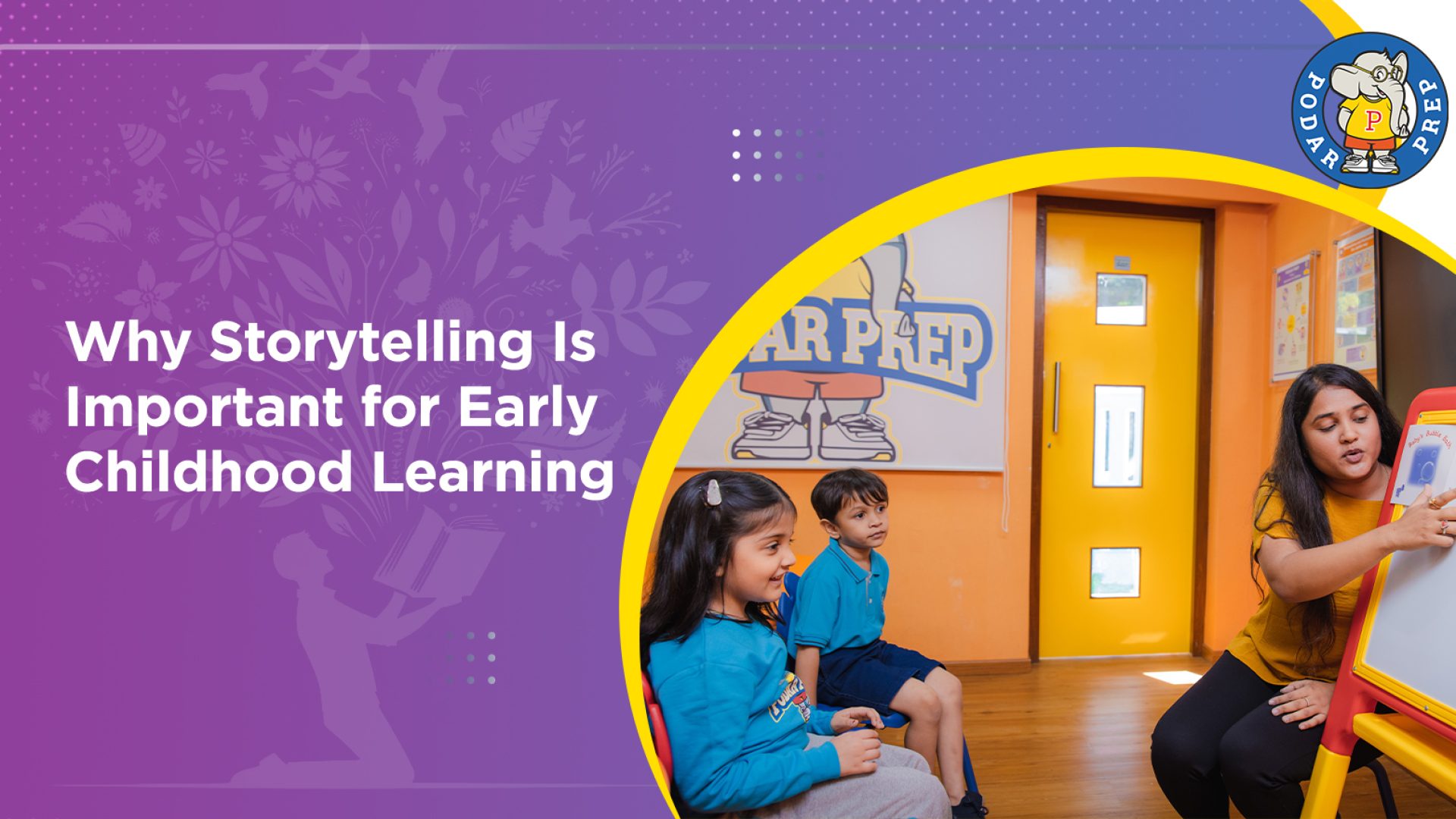
Story reading follows a book. The child gets the author’s exact words, the pictures on each page, and a story that stays the same every time. Storytelling has no page between the teller and the listener. There is eye contact, a voice that drops to a whisper, a pause before the scary bit, and sometimes the child’s own name slipped into the plot.
A study compared the two with children aged 4 to 6. Those who heard stories told did better at understanding and retelling them, while those who heard stories read from books began using more complex sentences. A child needs both, and usually in that order.
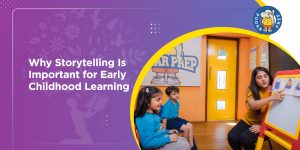
Podar Prep uses both techniques in their daily preschool activities:
- Circle Time features puppets and picture talk to tell the tale first.
- Symphonics accordion books provide the reading side, with one phonetic book sent home per child.
Put side by side, each one gives the child something the other cannot.
| Story reading gives | Storytelling gives |
| The author’s rich vocabulary | Eye contact and response |
| Pictures to point to | Freedom to change the plot |
| A book to return to | A memory of the teller |
What Are the Key Benefits of Storytelling for Early Education?
At Podar Prep, every curriculum unit begins with a story. This comes from Gijubhai Badheka, who believed that children learn best when a lesson starts with a tale. Teachers here see every day how one story can touch parts of a child’s growth. Three of those areas are:
Speaking, Listening and Vocabulary
Long before a child can read, language development happens through the ear. Rhymes, repeated lines and the chance to retell a story give children words they would not meet in everyday talk.
Teachers often notice that a child who is usually restless settles and focuses once a story begins. At Podar Prep:
- Narrating Picture Talk asks children to describe a picture, say what they think is happening and answer the teacher’s questions.
- Symphonics builds oral language before letters are introduced.
Thinking and Problem-Solving
Every question a child answers while listening to a tale is an act of reasoning, which is what Podar Prep means by H.O.T.S., or higher order thinking skills. Two of the school’s A-to-Z Learning Strategies build on this:
- In I See, I Think, I Wonder, children look at a picture from the story and share what they notice and what puzzles them.
- In Ask What If, they change one fact in the story and predict what happens next. Done this way, storytelling for kids becomes a thinking exercise as much as a listening one.
Feelings, Values and Belonging
A child who is not ready to talk about being scared will happily talk about a character being scared. Research on fairy tales suggests that the difference between kind and unkind characters is easier for young children to grasp than an abstract rule about behaviour.
Podar Prep chooses stories that carry values like kindness, honesty, sharing and courage. For this, teachers use puppets to draw out children who are shy in a group. Many of these stories come from Indian traditions, following Gijubhai and Tagore. Thus, what a child learns stays rooted in a world they recognise.
How Can Parents Continue Storytelling at Home?
Parents can build two habits to support this growth:
- First, tell a memory from your own childhood without using a book so your child experiences the raw telling side.
- Second, ask one question that has no right answer after finishing a bedtime book.
Podar Prep supports families through accordion books, interactive Home Play kits, and Kiducation Huddles where parents sit in on Circle Time. The Readers Make Leaders initiative also encourages this daily habit.
Give Your Child a Story-Led Start to Learning at Podar Prep!
The early years are when a child decides whether learning is something to look forward to. Stories are one of the gentlest ways to help that answer be yes.
At Podar Prep, every part of the day is child-centric, built on the Kiducation philosophy and aimed at holistic development. Teachers balance caution with encouragement, so children take small risks in their thinking and grow in self-belief. This practice supports their overall early childhood learning.
If you would like to see our story-led classroom, visit our website today and fill out the inquiry form for admission at Podar Prep.