Have you ever watched your three-year-old turn an empty shoebox into a bus? Each toy animal gets a ticket, the bus stops at Grandma’s house, and the driver announces every halt. Somewhere in the middle of it, you wonder whether this is only play or whether something is quietly being built.
In this one game, your child is inventing rules, holding a story in their head, and giving each animal a role. Let us look at what the research says, which preschool activities help, and how a Podar Prep classroom is planned around them.
Why Do the Preschool Years Matter So Much for Creativity?
Most parents know the early years are important, but it helps to see what that actually means for creativity in particular.
A 2026 study published in the Creativity Research Journal followed children aged four to first grade. The researchers found that children who showed richer fantasy in their pretend play had 4.91 times the odds of being in the group whose creativity grew the fastest.
This is why Podar Prep calls its teachers Brain Builders. These are the years when the brain lays down the pathways it will keep using. Hence, the quality of preschool learning in this window is more important in the long term than most of us realise.
Which Preschool Activities Help Spark Imagination?
Not all preschool activities carry the same weight. Some keep children busy, while some expand how they think. To see how these play out during an ordinary school day, here is a guide:
Stories and Imaginative Play
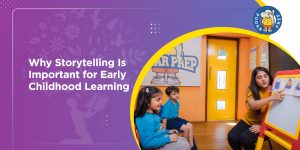
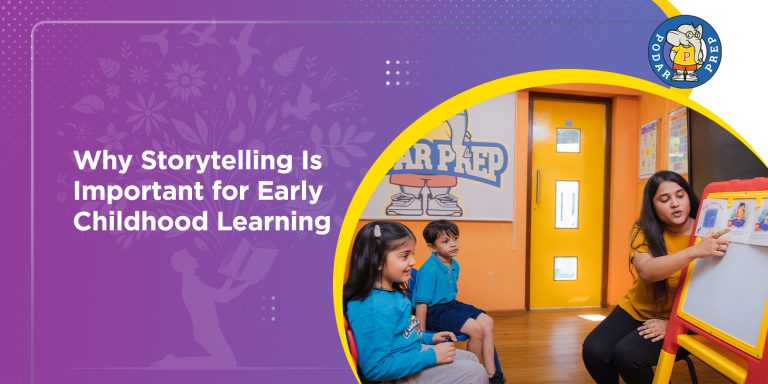
By reading a story to a child and letting them act it out, you help a child to work out what the character wants, what should happen next, and how to fix the given problem. At Podar Prep:
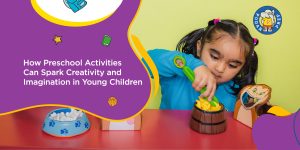
- Thematic Tours turn the classroom into a hospital or a pet clinic for the session, and children play their part.
- Puppet shows do a similar job for shyer children, who often find it easier to speak through a character first.
Hands-On and Open-Ended Materials
A 2024 study looked at children aged 5 and 6. It found that hands-on practice activities led to learning through discovery. The children had to put in their own effort, and that effort is what kept them engaged. Podar Prep includes this through:
- Sand play where children build, knock down, and build again with moulds and natural materials, without being told what to make.
- Froebel Gifts as a part of screen-free coding in three forms to encourage exploration. Forms of Life for building things children see around them, Forms of Beauty for patterns, and Forms of Knowledge for shapes and early maths.
When teachers provide these creative activities for kids, they ensure students build spatial awareness and logical reasoning independently.
Movement and the Senses
When children are free to run, spin, balance and climb, they start finding their own ways to move. This habit of trying something new with the body helps them think. Podar Prep includes:
- Action Mats where a child looks at the picture cue, works out what it is asking for, and does it, whether that is a Star Jump or a Tightrope Walk.
- The Immersive S.P.A. programme (Sensory Play Activities) goes a step further. It adds balance, body awareness and internal cues like hunger to the usual five senses. So kids know their bodies a little better each day.
The table below summarises these activities:
| Activity | At Podar Prep | Builds |
| Stories | “Let’s Spin a Yarn” circle stories | Sequencing and vocabulary |
| Role play/ Imaginative Play | Thematic Tours (hospital, supermarket, pet clinic) | Language and empathy |
| Open-ended materials | Froebel Gifts, sand play, blocks | Flexible thinking |
| Movement | Action Mats, Immersive S.P.A. | Body awareness and self-control |
How Do Teachers at Podar Prep Protect a Child’s Own Ideas?
A child shows us a block tower, and we ask, “What is it?” The question sounds harmless, but it may tell the child that the tower needed to be something. Young children pick up these small signals faster than we expect.
When a classroom is built around one right answer, they soon learn to wait for it instead of trying their own. A better response to that block tower is something like “Oh, that is interesting, tell me about it,” and then listening.
Inside a Podar Prep classroom, a few everyday practices from the Kiducation approach keep a child’s idea safe, such as:
- Teachers watch how a child thinks through a story-based problem.
- After free drawing, children talk about their picture and the teacher writes down what they said, word for word.
- The walls belong to the children. Their drawings and group projects go up, instead of store-bought decorations.
- Open-ended prompts like “Ask What If?” and “I See, I Think, I Wonder” replace ready answers.
What Can Parents Do at Home?
Podar Prep sends learning home through Home Play kits and the Symphonics accordion books that children read with their parents. Kiducation Huddles go a step further and invite you into class to experience a day the way your child does. Other than these:
- Keep a box of loose parts, such as cardboard, fabric scraps and bottle caps, within reach so a child can explore.
- When your child says “look what I made”, ask them a question about it rather than giving it a rating.
Support Your Child’s Creative Journey at Podar Prep!
That shoebox bus built by your child will probably be a rocket by next week. Whether this kind of thinking stays alive or fades depends on the preschool activities a child does every day.
At Podar Prep, our Kiducation philosophy looks at every day through the child’s eyes. Our Brain Builders are trained to protect a child’s own ideas. And our classrooms are set up so that children can build, pretend and move without being told what the result should be.
If you would like to see a Thematic Tour or a Kiducation Huddle for yourself, visit our website today and fill out the inquiry form for admission at Podar Prep.