Your 3-year-old child stands at the kitchen tap with a tall glass in one hand and a wide bowl in the other. The glass gets filled, tipped into the bowl, tipped back, and filled again. Then comes the question. Why does water look “more” in the glass?
The child does not know what the words science, maths or engineering mean, yet all three are happening at that sink. STEM (Science, Technology, Engineering and Mathematics) in the early years is noticing, testing and asking, long before it is introduced formally.
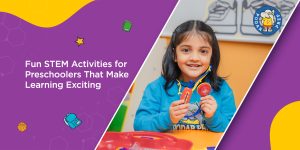
The best STEM activities for preschoolers are usually ordinary play with one good question added to spark curiosity. Scroll down to learn about various STEM activities that help your child.
What Is STEM and Why Is It Important for Preschool Years?
STEM stands for Science, Technology, Engineering and Mathematics. For preschoolers, it is a mindset rather than a set of subjects. A child looks at something, wonders about it and tries an idea.
Young children already sort, stack, compare and predict during play. STEM just gives these habits direction. A 2026 study compared preschoolers who took part in regular STEAM (Science, Technology, Engineering, Arts and Mathematics) activities with children who followed the regular programme. The STEAM group made stronger gains in problem solving. Teachers and parents also noticed better creativity, cooperation and emotional control.
These early learning activities ask children to try, fail and try again. This is why Podar Prep offers S.T.R.E.A.M. (Science, Technology, Reading & Writing, Engineering, Arts and Mathematics) inside its TRIKONA framework. The framework places it alongside story-based learning and the spiral curriculum
What Fun STEM Activities Can Preschoolers Try?
The STEM activities for preschoolers are grouped by strand. Each works at home with everyday things. These also show how a structured classroom builds on the same idea. Let us learn more about them:
Science Activities
Science at this age begins with the senses. Hunt for leaf patterns with a magnifying glass, mix two paint colours, or test which kitchen objects sink and which float. Science activities for kids work best when the adult asks “what do you see?” before asking “why?”.
Here is how this looks at Podar Prep:
- Children study leaf patterns under a magnifying glass and try a rainbow experiment during Understanding My World.
- Teachers use the “I See, I Think, I Wonder” strategy so children describe before they explain.
- Weather observation is part of daily life.
Technology Without a Screen
Try a treasure hunt, a “robot and programmer” game where one child gives commands and the other follows. Or a “missing step” game where your child teaches a doll to brush its teeth and spots what was left out.
Podar Prep takes this much further.
- India’s first Non-Screen Coding Curriculum teaches algorithms, looping and debugging through Froebel Gifts and coding toys.
- Children play programmer and gamer in pairs, then guide a robot such as Cubetto across a story grid.
- Decomposition is learnt by collecting every block before the sand timer runs out.
Engineering with Blocks and Everyday Materials
Engineering means to design something, test it, and try again when it fails. Build a tower until it topples, bridge two books with craft sticks, or race toy cars down a cardboard ramp. When the tower collapses, try not to fix it. The collapse is the lesson. This is where preschool STEM feels most like play.
Podar Prep builds on this in the classroom:
- Block play is used to explore balance, symmetry, size and position.
- DIY Assembly sessions have children build a dump truck using real tools.
- Froebel’s “modify but never destroy” rule means children change a design in stages rather than knocking it down.
Maths Through Movement and Nature
Numbers are easy to learn when children can hold them, jump on them or hunt for them. Count stones on a walk and sort them by size, go on a shape hunt in the garden, or chalk a number trail to hop along.
At Podar Prep, maths follows the same path:
- Number Magic follows the Concrete to Pictorial to Abstract (CPA) approach. So children match Number Pattern Tiles to the numeral on a Magic Spinner before they learn about a written sum.
- Measurement is introduced with a moon balance toy.
- ‘Math in Nature’ sessions take counting and shape hunts outdoors. Big number tiles get children moving.
How Do Sensory Play and Early Learning Activities Connect?
Young children learn best when they can touch, see, hear and move. Each new texture builds stronger neural pathways in the brain.
Podar Prep’s Immersive S.P.A. (Sensory Play Activities) programme goes beyond the traditional five senses to include all eight. It takes balance, body awareness and the internal signals that support self-regulation.
Action Mats add another layer, since a child reads a visual cue and decides which movement to make. This whole-body approach supports focus and emotional wellbeing. Here is how it is included:
- Vestibular activities like balancing and spinning for spatial awareness.
- Tactile exploration through sand play and texture stations.
- Proprioceptive tasks such as pushing and pulling to improve body coordination.
Let Your Child Build, Test and Wonder with Podar Prep!
For a child, curiosity is the raw material, and parents or teachers must help it grow into a question. The preschool you choose shapes how your child feels about learning. So it is worth choosing one that is brain-compatible, joyful and supportive.
Podar Prep’s S.T.R.E.A.M. curriculum, the Non-Screen Coding programme and Number Magic turn STEM activities for preschoolers into a daily habit. Its Brain Builder teachers are trained to hold back the answer, ask open-ended questions and let children test their own ideas.
To give your child these years of building, testing and wondering, visit our website today and fill out the inquiry form for admission at Podar Prep.